


Module 8 "Manufacturing Processes" focuses on understanding and transforming production systems to align operational efficiency with circular economy principles, integrating sustainability into daily industrial practice rather than treating it as a separate or secondary objective. The module examines how manufacturing can evolve from linear production patterns towards more resource-efficient and regenerative models within the furniture sector.
It addresses energy consumption in manufacturing environments, exploring how companies can measure, monitor and reduce energy use through process optimisation, technological upgrades and smarter resource management. It also analyses production planning as a strategic lever to increase efficiency, minimise material losses and develop more flexible, demand-driven and circular-oriented manufacturing systems.
In addition, the module covers waste management within industrial facilities, prioritising prevention, reduction, reuse and material recovery in line with circular economy principles. It highlights remanufacturing and reverse logistics as key mechanisms for retaining product value, extending lifecycles and reintegrating components and materials back into the production system. Finally, it introduces operations management from a Lean and sustainable perspective, combining continuous improvement methodologies with environmental objectives to simultaneously reduce inefficiencies, costs and ecological impact.

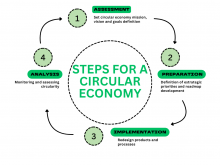
Module 9 "Circular Economy Transition Strategy" focuses on how organisations can move from isolated initiatives to a structured and long-term transformation, embedding circularity into their vision, governance and decision-making processes. Based on ISO 59004:2024 - Circular economy — Vocabulary, principles and guidance for implementation, the module provides a recognised framework to guide this transition.
It supports companies in defining a clear strategic roadmap for circularity, aligning environmental, economic and social objectives with their mission and business model. The module explores methodologies to assess the organisation’s starting point, identify gaps and prioritise actions with tangible impact across the entire value chain. It also presents planning tools that facilitate the integration of circular economy principles into corporate strategy, change management processes and organisational culture.
Particular emphasis is placed on the role of leadership, cross-departmental collaboration and stakeholder engagement in driving effective transformation. The module further addresses the importance of indicators and monitoring systems to measure progress, evaluate outcomes and continuously refine the strategy based on data and lessons learned. Through practical examples from the furniture industry, it demonstrates how companies of different sizes can structure their transition, overcome internal barriers and translate circular ambition into measurable and lasting business change.
